
What it's like keeping Emerald tree skinks
My favorite animals in the collection, and the ones I don't think get as much recognition as they should. This is what two captive bred skinks are like to live with, and what I've learned keeping them.
A definitive care sheet
I found this species through Clint's Reptiles on YouTube. I watched just how entertaining they were interacting with him, so I went online to learn more about them, and the problem was I couldn't find much information.
This is just my experience with two captive bred emerald tree skinks. I'm not a scientist, so take this with a grain of salt.
I did find one source that's different. Someone who actually keeps this species, shows their own animals, and knows what they're talking about. It covers a lot more than I will. If you want an authentic care guide, that's where I'd send you.
Emeraldtreeskinks.eu
A keeper-run reference site for Lamprolepis smaragdina built entirely around the keeper's own captive-bred animals. Species profile, subspecies and color forms, husbandry, terrarium builds, health, breeding notes, and a published lineage page. Every photo on it is of their own skinks.
This is one of the better resources I have found, and it covers all aspects of the animal, their care, and everything in between.
www.emeraldtreeskinks.eu →So what follows is the part I can actually add: what these animals are like day to day, and what surprised me.
What they're actually like
Google emerald tree skink and the first thing you get is a care guide posted five years ago. After that you find more of the same, a subreddit, a bioactive terrarium setup, then Facebook posts. There's just not a lot of information out there on them.
So it's worth finding as many sources as you can and putting the picture together yourself.
They've each got a personality
These are personable lizards. They watch you while you're in the room. They come to the glass. They interact. If you put your hand in there, they will climb on you. Just like any other reptile, their personalities can be very different from each other.
First I'd like to talk about my male. He's the most recent of the two I got, but he's the older animal. He's relentless. If you're in the room he will jump at the glass and he'll try to get up on you. But open the enclosure and he gets hesitant. He's a lot slower to actually come out than he is to throw himself at the glass to get your attention.
He was on the beat up side when I bought him. The people I got him from keep a colony in order to produce multiples for sale. They're breeding them in bulk.
When I first got him he hid all the time, I hardly ever saw him unless I really went looking for him. And when I did find him, he would take off running to the opposite side of the tank. Give it about six months. That's when his personality really started shining.
Now my female is a whole different story. I bought her when she was young, roughly five to six months of age. She still watches from afar, still monitors everything going on in the room, but she's a lot more reserved. If I walk over to the cage she tries to hide behind the branch she's sitting on. But if she's hungry she comes straight out and eats, no issue. Some days when I get lucky I can put my arm in there and she will run up my arm and onto my shoulder. The male prefers to sit on top of your head.
Even feeding them is different. He grabs the food and sits there where he's at and eats it. She grabs the food and runs off. She'll go to the top of the tank or to her little corner and just slowly munch away at it.
They aren't friendly the way a dog is friendly. They don't want to sit with you for an hour. It's more that they've decided you're not a threat, and after that you're mostly just another tree to climb on. Once you stop expecting affection and start appreciating a lizard that's interested in the world, they're great to keep.
They're also fast, so handle them low over something soft instead of standing up over a hard floor. Like most skinks they can drop the tail under real stress, and it doesn't come back the same.
Why they're like this
Emerald tree skinks come from Indonesia, the Philippines, New Guinea and the Pacific islands. Island animals evolve under far lighter predator pressure than mainland ones, and over time they lose a lot of their wariness toward anything that isn't a predator they grew up with. Biologists call this island tameness, or ecological naivete.
It's been measured in lizards specifically. A 2014 study in Proceedings of the Royal Society B compared 66 lizard species and found that flight initiation distance, meaning how close a person can get before the lizard runs, gets shorter the further a population sits from the mainland. Island lizards let you get closer.
So a lizard that watches you walk up instead of bolting hasn't been tamed. Its ancestors never needed to be afraid of something your shape. That explains what I see every day better than anything about where the animal came from.
None of which means sourcing doesn't matter. A wild caught import still arrives stressed, dehydrated and usually carrying parasites, and that's a serious welfare problem on its own. It just isn't the reason for the temperament, and I had that backwards before I looked into it properly.
How I keep mine
Cross-check all of this against the husbandry and terrarium pages on emeraldtreeskinks.eu, which go deeper than I do here.
Housing
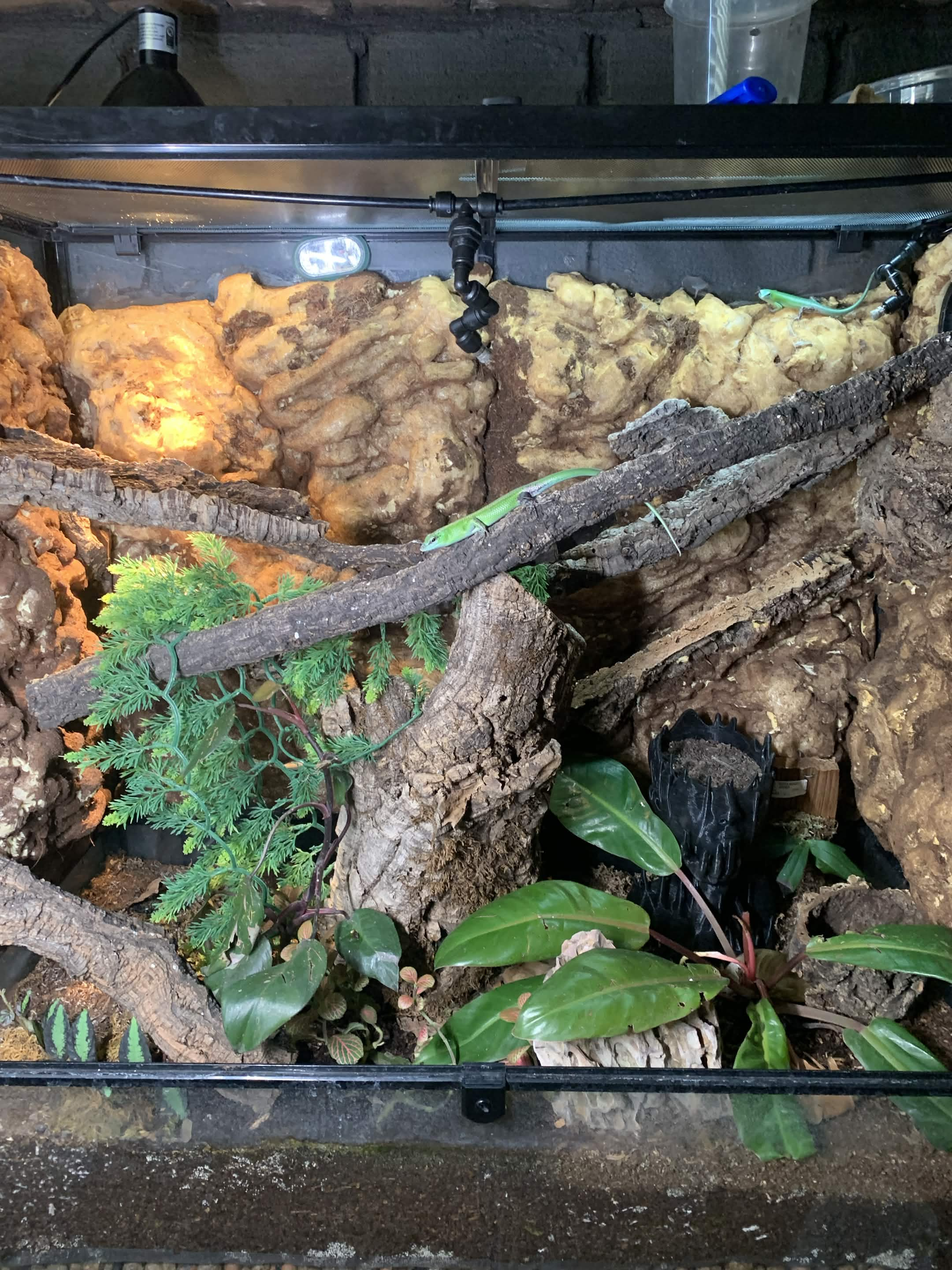
They live up. Mine spend the day moving through branches and basking high, and they almost never use the floor. Build vertically and the rest of the setup gets easier.
Go as tall as you can, front-opening if possible. Reaching down into an enclosure from above reads as a predator to an animal that watches the sky, and it makes every interaction slightly worse for no reason. Opaque sides and back with a clear front gives them somewhere to feel unexposed while you can still see in.
The background is worth the effort. Mine is expanding foam carved and covered on three sides, with coco fiber pressed into it and cork bark and rock set in while it was still wet. It gives them climbable surface on every wall instead of just the branches, which for an animal that lives vertically effectively multiplies the usable space in the enclosure.
A note about plants, and a confession
I built this setup planning for dense foliage up high. Conventional advice says arboreal species want cover near the basking area so they feel secure enough to use it, and I agree with it. So I bought a pink princess philodendron and an orange prince philodendron. Both climb, and both would have grown into exactly the vertical cover I was after.
My male hates plants.
He has personally destroyed both of those, along with a long list of others that never got the chance to root. He isn't hiding in them. He isn't eating them. He simply objects to their existence and acts on it. I put a plant in, he edits it out, and we repeat.
So my enclosure is lighter on high foliage than I'd like, and both skinks are out on the open branches watching the room regardless, which is at least consistent with everything else on this page. Take my setup as a picture of what one particular skink will tolerate rather than a recommendation. Give them the cover, they should have the option.
Just don't get too attached to any individual plant.
Furnish it with branches, vines and cork bark at multiple heights so they can cross the whole space without touching the ground, plus dense foliage near the basking area. Cover close to the warm spot means they'll actually use it.
Groups
They're usually kept with a skewed sex ratio, one male to two or more females. Worth being precise about what that means, because it gets described badly. It isn't that the females run things. The male is firmly the one in charge. You want the extra females so his attention is spread across several animals instead of landing on one, and so no single female carries all of it.
They also form social hierarchies within the group, and it's worth learning to see. There's an order to it, it sorts itself out, and it shows up in who takes the best basking spot and who gives way on a branch. Once you know to look, a lot of the small interactions in the enclosure start making sense.
Two males together is asking for trouble. If you're keeping a group, give more space and more sight breaks than you think you need, so an animal getting pushed around has somewhere to go that isn't a corner.
Heat and light
| Zone | Target | How to measure it |
|---|---|---|
| Basking surface | 95°F | Digital probe on the surface itself, or an infrared temp gun. Not a stick-on dial. |
| Cool side | 75-85°F | Probe at perch height, not on the floor |
| Night | 68-77°F | Room temperature is usually fine |
Every heat source goes through a thermostat. No exceptions.
Lighting is two separate jobs and this is where people most often get it half right. A diurnal, sun-loving species needs UVB and it needs visible brightness, and one bulb doesn't do both. Run a linear T5 HO UVB fixture, and separately a bright daylight lamp spanning most of the enclosure length. A UVB tube alone is nowhere near bright enough, and dim enclosures produce dull, inactive, hiding animals.
Two bonuses to running proper bright light that people don't always think about. Your plants will be grateful for it. If you want a planted or bioactive setup that actually thrives rather than slowly declining, the lighting you install for the skink is the same lighting the pothos and philodendron have been waiting for. And there's a health reason covered below.
Getting UVB right
UVB is the part of the setup where guessing costs the most, in both directions. Too little and you get metabolic bone disease over months. Too much and you can hurt the animal in a weekend.
Distance genuinely matters. UV output falls off sharply with distance, so the same bulb can be correct at one mounting height and useless or dangerous at another. Whether the fixture sits above mesh matters too, since screen can cut a substantial share of what gets through. This is why copying someone else's exact setup rarely transfers. Their basking branch is not at your height.
You can measure this instead of guessing. Reptile UV index meters exist for exactly this purpose. The Solarmeter 6.5R is the common one, reads 280 to 400 nm as a UV index figure, and has a Ferguson zone chart printed on the meter itself. You hold it at the spot the animal actually basks and read the number. If you're going to run UVB seriously, or you're setting up a species you haven't kept before, it's worth the cost once rather than hoping annually.
Too much UVB is a real injury
An animal that sits too close to a bulb for too long can develop photokeratoconjunctivitis, sometimes called UVB sickness. It's essentially sunburn of the cornea and the tissue around the eye. Signs are swollen or shut eyes, a skink that stops basking, stops eating, and goes inactive. It's painful, though it's generally reversible once the cause is removed.
Here's the part that ties back to brightness. A dim enclosure makes it worse. In low visible light the pupil stays dilated, which lets more UV into the eye. So a setup with strong UVB and weak visible light is the bad combination, and running proper bright daylight alongside the UVB is protective as well as good for activity and plants.
Always give a gradient. The animal needs to be able to choose a spot with less exposure, and needs shade and cover to retreat to. Never a setup where the only comfortable perch is directly under the tube.
Write the install date on the fixture in marker. UVB output fades long before the bulb stops producing visible light, so a tube that looks fine can be doing nothing.
Humidity, the actual hard part
If someone asks why this is an intermediate species rather than a beginner one, this is the whole answer. It isn't that they're fragile. It's that high-humidity species are difficult in general, and plenty of people don't realize that's what they signed up for until something has gone wrong.
The mistake that causes real problems
Humidity and ventilation are not a trade-off you pick between. You need both at once, and that's genuinely harder than it sounds. Sealing an enclosure to hold moisture gives you warm stagnant air, which gives you mold and respiratory infections that are difficult to reverse.
What you want is a well-ventilated enclosure that you rewet on a schedule, not a sealed one that never dries out. If the glass is permanently fogged and the substrate smells sour, the setup is wrong even when the hygrometer reads perfectly.
Put the hygrometer probe where the animal actually spends its time, up at perch height rather than on the floor or at the lid. A reading from somewhere the skink never goes is a number that makes you feel good while the animal has a problem.
I run an automatic misting system twice a day. I also still mist by hand during the day, because St. George is high desert and the ambient air here will pull moisture out of an enclosure faster than the schedule can put it back. If you live somewhere dry, budget for that. Whatever misting routine works for someone in a humid climate will not be enough for you.
The wet and dry cycle is bigger than it sounds
I used to think of the seasonal cycle as a nice-to-have, the kind of detail you get to once the basics are dialed in. Looking into it properly changed my mind.
In the tropics there isn't much seasonal swing in day length or temperature, so the cues that tell a temperate reptile what time of year it is barely exist. What does change is rainfall. For a lot of tropical species the shift from dry season into wet season is the calendar, and it's what drives the reproductive cycle. Skink genera split on this, with some breeding in the wet season, some in the dry, and some year round, so it isn't one rule for the whole family. But rainfall doing the work that temperature does elsewhere is well established.
Keepers report the practical version of this bluntly: some emerald tree skinks won't seriously attempt to breed until they've been through a proper heavy wet period first. Not a slightly damper week. An actual season.
So if you're just keeping them, cycling humidity is still worth doing because it's closer to what the animal evolved with than one flat number held all year. And if you ever want to breed them, it stops being optional and becomes the thing you plan the year around. Exact target ranges are on the husbandry page at emeraldtreeskinks.eu.
Food
Primarily insects, with some fruit. Feeding response in a healthy captive-bred animal is enthusiastic to the point of comedy, which is also why hand feeding works so well with them.
- Rotate feeders rather than running one item, for variety and to cover nutritional gaps
- Gut-load for at least 24 hours before offering. An insect is only as nutritious as its last meal
- Dust with calcium and a multivitamin on a schedule matched to your UVB setup
- Fruit occasionally, as an addition rather than a staple. Prepared crested gecko diet works well for this too, and it's convenient if you already keep cresteds or gargoyles and have it mixed. Treat it as an occasional supplement rather than a replacement for insects, since these are not the fruit-heavy feeders cresteds are
- Shallow water dish changed daily, and they'll drink droplets off leaves after misting
Health and quarantine
Get a fecal float done within the first 30 days, whatever the animal's history. This species has a documented parasite problem and catching it early is straightforward, while catching it late often isn't.
Wild-caught imports commonly arrive with flagellate protozoa, nematodes and mites, and generally need veterinary treatment rather than hope. Even genuinely captive-bred animals can carry pinworms, so the fecal isn't something you skip because you trust the breeder.
Quarantine new arrivals away from the rest of the collection, in a simple setup with paper substrate where you can see what's coming out of the animal.
Color is the easiest daily health check you have. A bright green skink is generally a well one. A dull or grayish animal is usually telling you something, and it's worth investigating before anything else shows up. Beyond that, watch for weight loss, labored or open-mouthed breathing, retained shed around toes and tail tip, or a skink that suddenly stops coming to the front. Weigh regularly and log it, because weight tells you an animal is in trouble weeks before it looks like it.
Where to get one
Buy captive bred, and do the work to confirm it's actually captive bred rather than taking the label at face value. Most animals offered for sale are still wild-caught imports, and that single decision affects the animal's health, its temperament, and whether the trade that produced it keeps paying.
The short version: ask for the hatch date and the parents, ask what it's been eating and for how long, and buy from the person who hatched it wherever you can. The big marketplaces are not where the real breeders of this species tend to be. Species-specific groups are.
Start with the community, not a marketplace
The people actually breeding this species are not on the big listing sites. They're in species-specific communities, posting clutches as they hatch, where reputation is visible and everyone has known each other for years. Some of those groups keep vetted lists of breeders people trust, which is worth considerably more than any marketplace filter.
Getting into those circles takes a while if you're starting from nothing, and knowing which ones are worth your time takes longer. So rather than send you off to figure that out alone:
Need help finding a reputable source?
Message me. I'll point you toward the communities and the people I'd buy from myself, and I'll look at any listing you're considering and tell you honestly what I think it is.
This isn't a sales pitch. It applies whether or not it's a species I keep, whether or not I have anything available, and whether or not you ever buy a thing from us. I would rather you ended up with a healthy captive-bred animal from someone good than a cheap import from someone who didn't tell you what it was.
Ask me about sourcingI've written the long version separately, including what the research has actually documented about laundering and how to find a breeder worth buying from:
Is this the right lizard for you?
These are an intermediate species. Not the easiest reptile you could keep, not remotely the hardest. The difficulty is humidity, not the animal.
What you get in exchange is a lizard that is awake all day, genuinely sociable, and visibly interested in whatever is happening in the room. That's rare, and it's why I'd tell most reptile keepers to consider one.
Get one if
- You've kept reptiles before and you're comfortable reading a setup and adjusting it rather than following instructions
- You understand what maintaining high humidity alongside good ventilation actually involves, or you're willing to learn it properly first
- You want an animal that's awake, visible and interactive rather than one you look at
- You're prepared to hunt for a genuinely captive-bred animal instead of buying the first one you find
Wait, or pick something else, if
- This would be your first reptile. Start with something that forgives mistakes, then come back to this one
- You want a lizard that will sit still and be held. They'll climb on you happily, but on their terms and not for long
- You can't commit to the enclosure size and lighting from the start. This isn't a species to upgrade into later
- The only animals you can find are imports, and price is the reason you're considering it
Thinking about one? Ask me first.
Send a photo of your setup and what you're planning. I'll tell you honestly whether it's a fit, what it would take to get there, and how to check whether the animal you've found is really captive bred. No charge, and no pressure to buy anything from us.
Sources and further reading
- Emeraldtreeskinks.eu, keeper-run reference site. Adult length, lifespan, temperament and care level figures above are from this source, and it's the best reference on the species available
- Island tameness, the concept behind the temperament section
- Cooper, W. E. Jr., Pyron, R. A. & Garland, T. Jr. (2014). Island tameness: living on islands reduces flight initiation distance. Proceedings of the Royal Society B 281(1777), 20133019
- Solarmeter Model 6.5R reptile UV index meter
- ReptiFiles emerald tree skink care sheet, for cross-referencing husbandry parameters
- The Bio Dude, emerald tree skink bioactive setup guide